
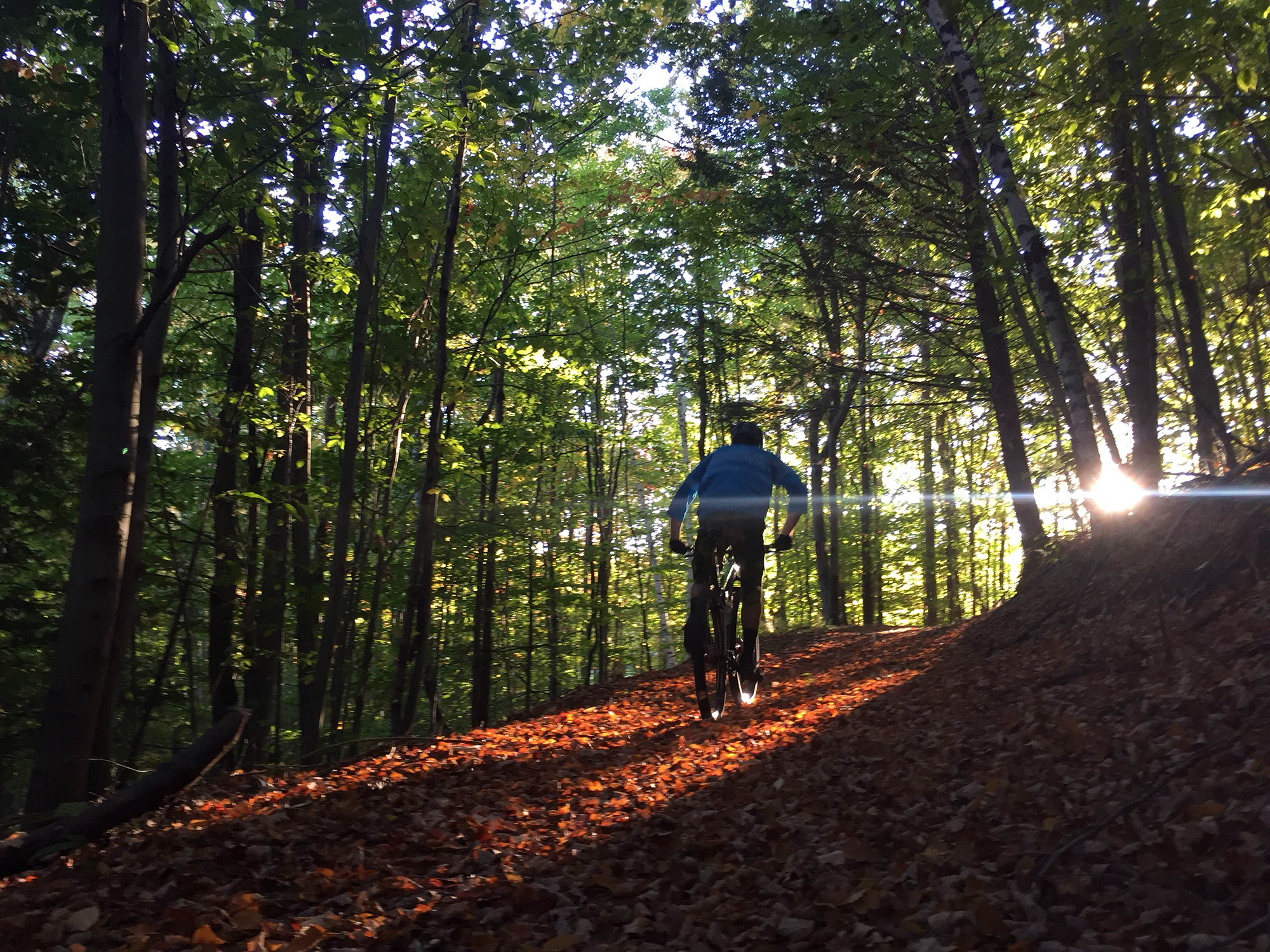



Stowe Trails Partnership is excited to announce that “Type 1” Pedal-Assist E-Bikes are officially allowed in the Sterling Forest trail network. We have received permission from our Land Access Partners to allow e-bikes as part of a year-long pilot project. E-bikes are ONLY allowed on the multi-use trails which are currently open to mountain bikers within Sterling Forest. The pilot project will begin in September 2021 and will run through October 2022.
During this time, STP will be monitoring the trails to ensure that E-bIkes can successfully co-exist with other trail users without any adverse impact on the natural environment. Please take a couple of minutes to fill out our survey and let us know your thoughts on allowing e-bikes on trails.
With this decision, STP strives to make our trails more accessible for all, regardless of ability, age, or health issues. We strive to be a more welcoming and inclusive organization so all can enjoy access to nature. Expansion of this policy to other parts of the Stowe trails network will be in conjunction with our land access partners and based on our collective review of the results demonstrated in Sterling Forest.
Sterling Forest is well suited to take advantage of the unique benefits of pedal-assist bikes. Pedal assist allows for longer-range rides for those with mobility issues to get out and enjoy the trail.
Ride Respectfully
We ask all trail riders to adhere to IMBA’s Responsible Riding guidelines. As the use of E-Bikes is currently a pilot project, this puts extra responsibility on every E-Bike rider to ensure they are having positive interactions with other trail users. As many of Stowe’s trails are bi-directional, it’s important that descending riders yield to climbing riders in accordance with the IMBA guidelines. Only pass when it is suitable for both riders – it’s best if the trailing rider waits for the leading rider to yield or reach a good stopping place.
- Know Before You Ride: Only ride trails that are posted as being open for E-bikes. Never ride your E-bike on a trail that doesn’t allow electric-assist bikes. Ignoring local trail use laws can give a bad name to other E-mountain bikers! Check Trailforks or Stowe Trails Partnership’s website for locations and more information.
- Stay On the Trail. Whether you are on an electric mountain bike or a regular mountain bike, always stay on the designated trail. Don’t cut corners, ride through vegetation, or create shortcuts, it could damage the trail and/or surrounding wildlife.
- Stay Off the Trail When it’s Wet. Rock, sand, clay, or loam – trail surfaces vary depending on location. If it has rained recently, it’s always best to check on current trail conditions. Riding on muddy or soft trails can cause significant trail damage.
- Within 24-36 hrs of rain, please check our Conditions page as to whether trails are open: StoweTrails.org/Conditions
- Keep Your Speed in Check. Although going fast on your E-bike can be fun, it can also be dangerous to yourself and others. When riding near other trail users, slow down. If you must pass, be polite. Ask the other rider or hiker if you can pass and allow them to respond before maneuvering around them. Also keep in mind that the faster you go, the more difficult the trail will become. Look ahead and make sure to check your speed for upcoming trail obstacles and corners.
- Yield to Riders and Other Users. Many of Stowe’s trails are bi-directional, and it’s important that descending riders yield to climbing riders in accordance with the IMBA guidelines. Only pass when it is suitable for both riders – the best practice is for the trailing rider to wait for the leading rider to yield or reach a good stopping place. Yield for all other trail users.
What is an E-Bike?
By the existing federal definition, e-bikes are two or three-wheeled cycles with fully operable pedals and an electric motor assist of no more than 750 watts (also known as 1 horsepower). For those familiar with wattage, that figure is a bit misleading, as it is peak power output – almost all modern eMTBs have a nominal power output of 250 watts.
There are 3 primary classes of eMTBs: Class 1, Class 2, and Class 3. Class 1 e-bikes have an electric assist that ceases to provide assistance when the bicycle reaches the speed of 20 miles per hour, and the electric motor works only when the rider is pedaling (referred to as “pedal-assist”). Class 2 e-bikes are also limited to a top assisted speed of 20 miles per hour but include both pedal-assist and a throttle that can be used without pedaling. Class 3 bikes have an electric assist limited to 28 miles per hour and are also pedal-assist,
When we refer to eMTBs, we typically are talking about Class 1, pedal-assist mountain bikes, and not throttled bicycles of any kind. All eMTBs presently produced by major bicycle companies in the US are Class 1.
What Trail Networks Are E-Bikes Allowed in Stowe?
Currently, electric mountain bikes are only allowed in the Sterling Forest trail network.
How Are We Handling E-Bike Concerns?
Vermont Mountain Bike Association (VMBA) acts as the umbrella organization for 29 Chapters, including Stowe Trails Partnership. We are working closely with them to learn all we can about e-bikes and how they impact the following four areas:
- Environmental. Initially, the presence of a motor on these bicycles led to concerns that eMTBs would produce more trail tread damage, as it is well-established that off-road motorcycles and ATVs remove substantially more material from trail surfaces than hiking or mountain biking (Natural Resource Impacts of Mountain Biking – American Trails). A recent study, however, showed that the tread impacts of eMTBs are essentially the same as analog bikes, and that behavioral choices – e.g. riding on muddy trails – can have a much more profound impact. Nonetheless, if eMTBs enable riders to cover more distance and ride longer, the overall impact of a rider on a given day could be greater.
- Social. Class 1 eMTBs allow a rider to travel at higher speeds (limited to 20 mph) uphill, which could result in them encountering and overtaking more trail users along a given stretch of uphill or flat trail. This could lead to more disruptions and an overall less positive experience for other users – including analog mountain bikers. It is worth noting that the electric assist for Class 1 eMTBs cuts out at 20mph, these bikes do not travel significantly faster than analog bikes downhill, and that the uphill speeds achieved by eMTBs are similar to those of very fit riders on analog bikes, as demonstrated in a recent environmental assessment in the Tahoe National Forest.
- Safety. The pedal assist capability of eMTBs can allow users to pedal deeper into trail systems than they would on an analog mountain bike, and travel at higher rates of speed on certain – predominately uphill – sections of trail. The related concern is that those on eMTBs could either find themselves in over their head – should a battery die, for instance, or lead to speed-related crashes over certain terrain.
- Legal. If and when trails are opened to eMTBs, their designation can change from ‘non-motorized’ to ‘motorized’, as is presently the case for trails on USFS land. This reclassification can have significant implications for funding and regulations, and affect whether specific trails are eligible for certain grant programs, trail manager liability, etc.
The overarching concern is what these impacts could mean for access – if eMTBs are permitted on a trail and significant additional negative impacts to the environment, user experience, and/or safety were to occur, the potential for the trail to be closed to all mountain biking is real.
Learn more about e-bikes and existing policy.
Additional Resources
- Vermont S.66 (Act 40), A bill relating to electric bicycles
- Kingdom Trails Association eMTB policy
- USFS Guidance on eMTB use in National Forests
- IMBA eMTB FAQs
- BLM – e-Bikes on Public Lands
- NEMBA’s position statement on eMTBs
If you have any questions about the use of E-Bikes on the Stowe trails network, please reach out to our Executive Director at carolyn@stowetrails.org.